

UNDERSTANDING COCO COIR
Coco Coir vs. Soil: Understanding the Difference
For most new growers, "growing a plant" means putting it in soil. But when you move to a professional tent setup, you’ll find that Coco Coir is the preferred choice for high-yield results. While it looks like dark, rich dirt, it behaves very differently.
1. Soil is a "Buffet" vs. Coco is a "Spoon-Feed"
Soil: Think of soil as a pre-loaded buffet. It contains organic matter (compost, peat, manure) that slowly breaks down into food for the plant. You just add plain water, and the plant eats what is already there.
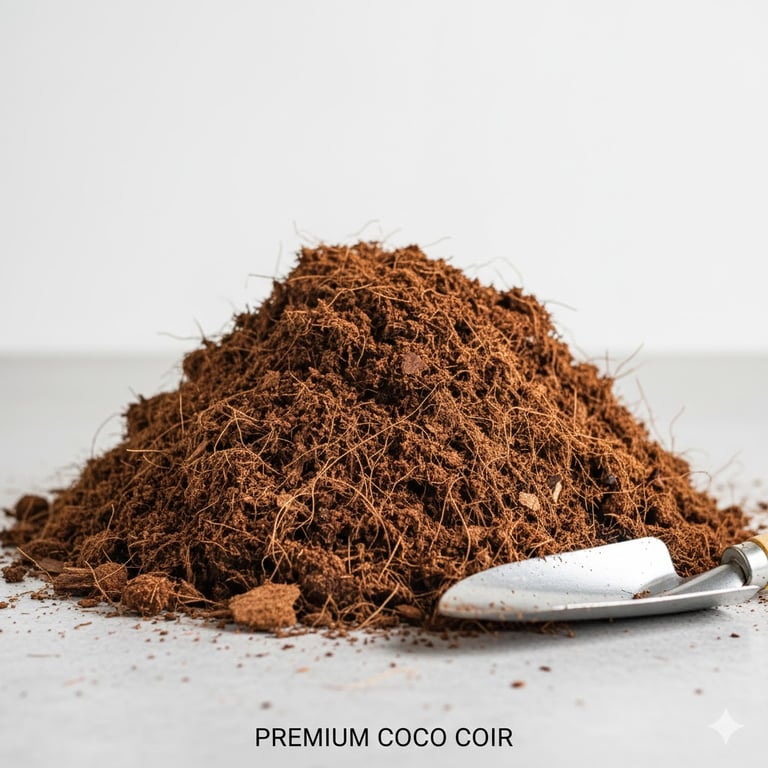
Coco Coir: Coco is inert, meaning it has zero nutritional value. It is essentially a pile of ground-up coconut husks. If you give a plant in coco plain water, it will eventually starve. You must "spoon-feed" the plant by mixing liquid nutrients into every single gallon of water.
2. The Oxygen Advantage
The biggest killer of plants in soil is "overwatering." Soil particles are small and can pack together, suffocating the roots. You will hear grower's refer to this as "over watering". Coco Coir has a unique cellular structure that naturally holds onto oxygen, even when it’s soaking wet. Because roots need oxygen to "breathe" and process energy, the high aeration in coco allows the plant to grow up to 30% faster than it would in traditional soil.
Advantage of Air Pruning - use Fabric Pots!
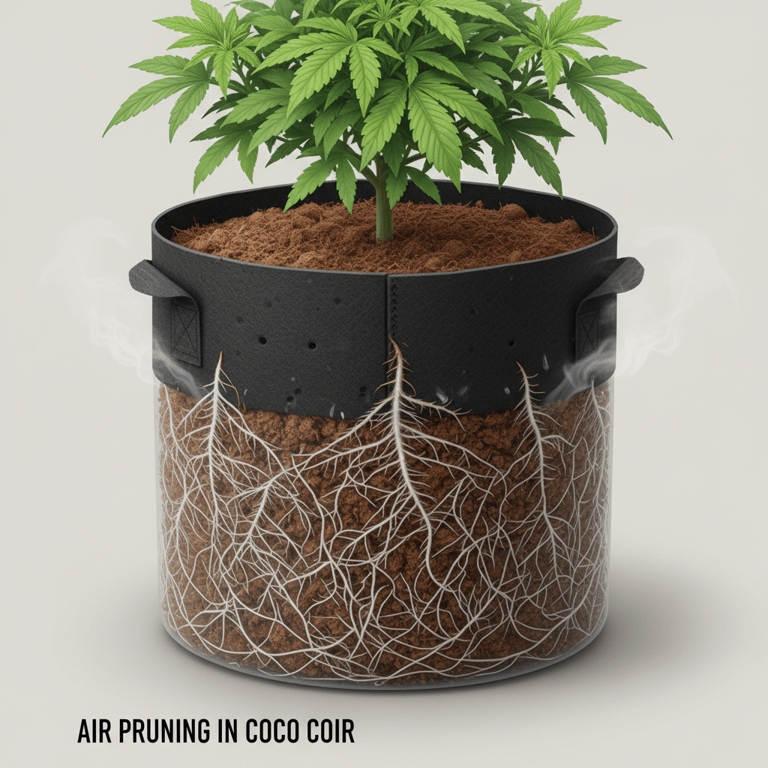
When you combine the sponge-like qualities of coco coir with the fabric pots shown in our diagram, you unlock a powerful biological process known as Air Pruning. Unlike traditional plastic pots where roots hit a hard wall and begin to spiral into a "root-bound" knot (suffocation), fabric pots allow the root zone to breathe.
As a root tip grows toward the edge of the container, it encounters the air passing through the porous fabric walls. This exposure naturally dehydrates the tip, causing it to stop growing forward in a process called self-pruning. Rather than being a disadvantage, this actually signals the plant to explode with life from the center, sending out hundreds of new, tiny feeder roots to fill the space.
The ultimate result of this cycle is a massive transformation in the root architecture. Instead of a few long, strangled roots circling the bottom of the pot, your coco coir becomes home to a dense, fuzzy mass of millions of high-efficiency roots. Because the plant now has a vastly increased surface area to drink from, it can absorb nutrients much faster, leading directly to the explosive growth and bigger yields every grower wants.
3. Hydroponics Made Easy
Technically, growing in coco is a form of hydroponics. In soil, the plant has to work hard to find nutrients. In coco, because the nutrients are delivered in a water-based solution directly to the roots, the plant spends less energy "searching" for food and more energy building big leaves and heavy flowers.
4. pH Control
Coco is sensitive. Because it’s an inert medium, the pH of your water determines whether the plant can actually "see" the food you're giving it. This is why a pH meter is a required tool for any coco grower. Always pH last and keep your pH between 5.8 and 6.2 aim for the center 6.0.
Using Coco Coir will require you to spend more time in your garden. In exchange you will get the explosive growth rates of a high-tech hydroponic system but with the physical stability and "feel" of traditional gardening. It is the best of both worlds.

Contact
THESOURCE@MAIL.COM