

UNDERSTANDING HYDROPONICS
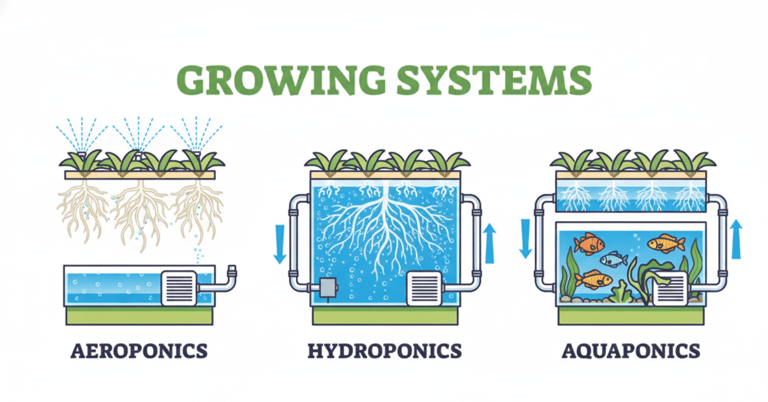
Hydroponics is the science of growing plants without a single grain of soil. Instead of roots pushing through dense dirt to find food, they sit in a nutrient-rich water solution. By delivering food and oxygen directly to the root zone, the plant spends zero energy "searching" for nutrients and 100% of its energy on growing. The result? Faster growth cycles, massive yields, and total control.
Ways to Grow: Choosing Your System
1. Deep Water Culture (DWC)
In DWC, your plant sits in a net pot filled with clay pebbles, suspended over a bucket of water full of essential nutrients your plant needs. The roots hang down directly into the "soup" of nutrients. An air pump pushes air through a "stone" at the bottom of the bucket, creating constant bubbles. Oxygen is essential for all plant growth so without the air stones the roots will simply drown.
2. Reciprocating Deep Water Culture (RDWC)
This is DWC's "big brother." Instead of individual buckets, you have multiple plant sites connected by PVC pipes to a central "master" reservoir.
How it works: A pump constantly circulates the water from the main reservoir to the plants and back again.
Why it’s great: You only have to check the pH and nutrients in one spot instead of ten different buckets.
3. Ebb and Flow (Flood and Drain)
This system uses a tray and a reservoir. The plants sit in the tray, and the water stays in the reservoir below.
How it works: A timer turns on a pump that floods the upper tray with water. After a few minutes, the pump turns off, and the water drains back down.
Why it’s great: As the water drains, it pulls fresh oxygen down into the roots, preventing rot.
4. Nutrient Film Technique (NFT)
Commonly used for lettuce and herbs, this uses a slightly tilted channel or tube.
How it works: A constant, thin "film" of water flows down the channel, over the very tips of the roots, and back into the tank.
Why it’s great: The top of the root system is always exposed to air, while the bottom is always drinking.
5. Aeroponics
This is the most "high-tech" method. The roots hang in a dark chamber with no water at the bottom.
How it works: High-pressure nozzles mist the roots with a fine spray of nutrients every few minutes.
Why it’s great: Because the roots are surrounded by 100% air, they grow at hyper-speed. However, if the power goes out, the roots dry out in minutes.
Getting Started: Germination
You can't put a seed in a bucket of water; it will drown. You must germinate first.
The Media: Use Rockwool or Rapid Rooter plugs.
The Soak: Soak the plug in pH-balanced water ($5.5$) and place the seed inside.
The Move: Once roots poke out of the plug (usually 7–10 days), place the plug into your hydro system's clay pebbles.
The Stages of Growth (Example: Cannabis)Seedling: Very low light, high humidity, and low nutrients (200–300 PPM).
Vegetative: The plant grows leaves and stems. Needs 18+ hours of light and high Nitrogen (500–800 PPM).
Flowering: The plant produces buds. Needs 12 hours of total darkness and high Phosphorus/Potassium (800–1200 PPM).
Water Chemistry:
Optimal Temperatures
Water temperature is the most overlooked factor for beginners.
The Sweet Spot: 18°C – 21°C (65°F – 70°F).
Why it matters: At 22°C (72°F) and above, water loses its ability to hold oxygen. This leads to drowning—the plant suffocates because it can't "breathe" through its roots, even though it's surrounded by water.
pH & PPM
pH (Potential Hydrogen): In hydro, your pH must stay between 5.5 and 6.3. If it’s too high or low, the plant's roots "lock out" and cannot absorb food.
PPM (Parts Per Million): This measures how "thick" your nutrient solution is. Think of it like the "calories" in the water. Too high, and you burn the plant; too low, and it turns yellow from hunger.
Enzymes vs. MicrobesMicrobes (Living): Think of these as "Good Bacteria." They live on the roots, eat pathogens, and help the plant digest food.
Enzymes (Non-Living): These are biological catalysts. Their job is to find dead, decaying root matter and "dissolve" it into simple sugars for the microbes to eat. When roots grow into a giant, solid mass, they can't get oxygen in the center. Enzymes help keep the root mass clean and efficient.
The Essential Toolkit To run a successful hydro grow, you cannot guess. You need these tools:
pH Pen: To test acidity daily.
PPM/EC Meter: To see how much "food" is left in the water.
Water Thermometer: To ensure your reservoir isn't getting too hot.
Air Pump & Stones: The bigger the bubbles, the faster the growth.
Thermostats/Heaters: If your water gets below 15°C (60°F), the plant will stop growing entirely.
Mastering hydroponics is about shifting your mindset from "gardener" to "pilot." By controlling every variable—from the oxygen-rich bubbles in your reservoir to the precise chemical balance of your nutrients—you are removing the limitations of nature and unlocking your plants' true genetic potential. While the initial learning curve regarding pH, PPM, and water temperatures may seem steep, the reward is a cleaner, faster, and more abundant harvest than soil could ever provide. Stay diligent with your measurements, keep your equipment sterilized, and watch as your garden transforms into a high-performance growth machine.



Contact
THESOURCE@MAIL.COM